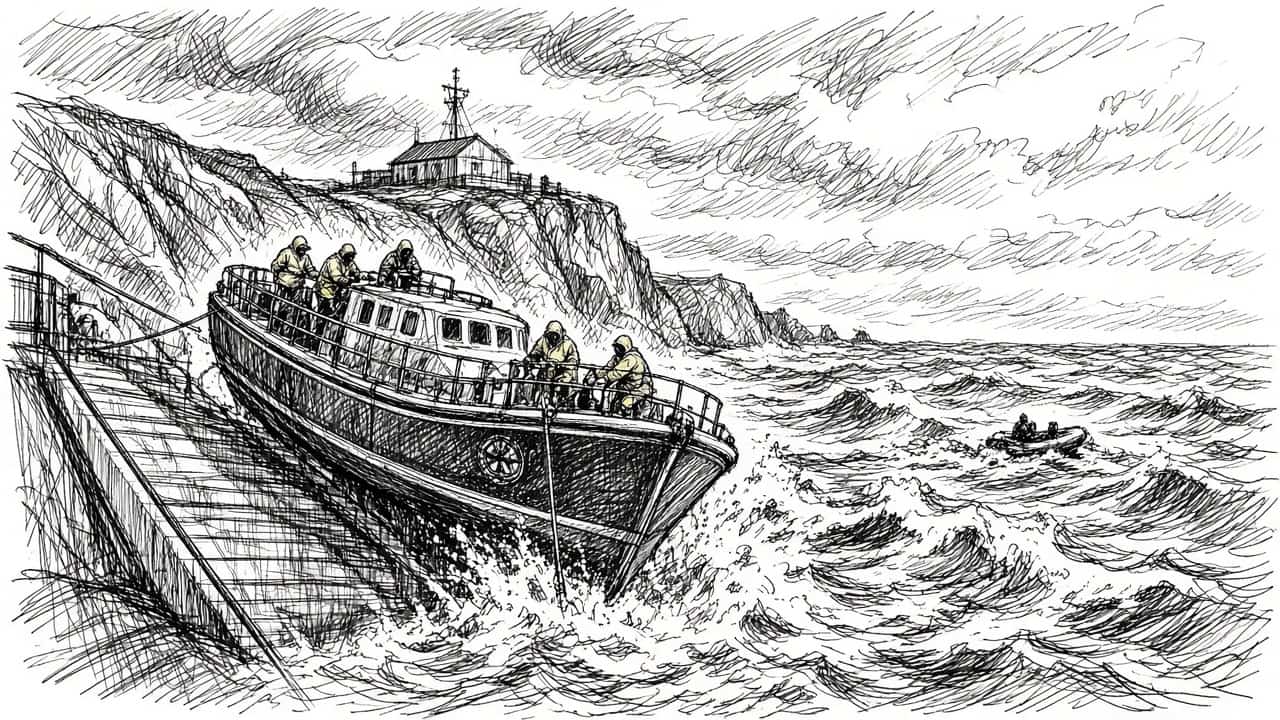
The question drew a clear refusal to prohibit rescue: No won with 471 votes to Yes’s 283. The winning side’s case was less a defence of crossings than a line around the moment of danger — “RNLI statutory task is to rescue” — with the floor’s most-respected No argument insisting that people should be saved before responsibility passes to Border Force.
That position came with conditions. Several No voters wanted a sharper division between saving lives and transporting people, arguing for “Rescue and return. Simple.” Others called for penalties, detention or a dedicated government response, rather than asking volunteers to make moral or legal judgments in the water.
Yes voters did not mainly argue that drowning people should be abandoned; their sharper case was that the RNLI was being drawn into an operation beyond rescue. The floor’s strongest Yes voice said those who deliberately took the risk had “disqualified themselves from assistance”, while another argued that lifeboats should intervene only where there was an “immediate risk to life”. The two sides talked past each other: one treated any prohibition as a licence to let people die, the other treated routine deployment as the mechanism sustaining the crossings.
The debate therefore landed inside the wider immigration argument about deterrence, enforcement and the limits of charitable duty. Yet the room’s own terms showed substantial overlap: even a Yes voter wrote, “The issue is not whether they rescue but rather where they take them to after they rescue”, while a No voice said the service should not be “a mean of transportation”.
The verdict was against banning the RNLI, not for leaving the policy problem untouched: save first, then make the state answer for what follows.




53 Opinions
In retrospect, my vote looks harsh. But I was simply thinking that if we made it clear that we wouldn't respond, the onus would fall on the French to refrain from leading people into our territorial waters and to abandon them.
RNLI statutory task is to rescue therefore prohibiting them from it is nonsense. There are few issues though - they should not be a mean of transportation where is no real danger for life, they should return saved to place where they started the journey. Navy or Border Force should stop boats from entering our territorial waters.
The migrants by purposely putting themselves at risk are endangering others and so have disqualified themselves from assistance from the RNLI
There should be legal penalties for illegal crossings, in the same way that people can be prosecuted for nuisance calls and false alarms. Of course people should be rescued, but the service is overstretched, and taken advantage of.
This is a poorly worded question which is framed to elicit a sympathetic vote in favour of the RNLI. I did vote no because there are clearly instances where boats find themdelves in difficulty, putting lives in danger, but I vehemently disagree with the RNLI providing a taxi service when there is no present danger, particularly when they are known economic migrants intent on entering the country illegally.
The RNLI has one purpose - rescue people at sea. No ifs, no buts, no questions. To restrict who can and can't be rescued defeats the point of the charity, staffed by volunteers who do not deserve abuse.
Let's not be cruel now... regardless of what people think of these illegal migrants, they shouldn't just be left to drown at sea.
No, of course not, and this logic is just the tip of the iceberg. People are drowning, and the RNLI has the means to stop that hideous, painful death, and so they should use it - regardless of the motives of the people about to die. We do not live in a society where we judge people who are victims, or at risk, and nor should we ever aspire to do that. Smoke cigarettes? No NHS for you, then. Drive over the speed limit of the motorway and have an accident? No ambulance for you.
All life is precious
The RNLI should only be tasked in the event of an emergency, shadowing vessels into port is not their duty it is that of Border Force. If the RNLI are busy on a "just in case" mission who will be there for the genuine emergency?